Work must be done to stretch a spring. This work is stored in the spring as elastic potential energy and is released when the spring returns to its original length.The energy stored is the area under the force-extension graph. The force is not constant during stretching: it increases steadily from zero to F, so the average force is ½F.
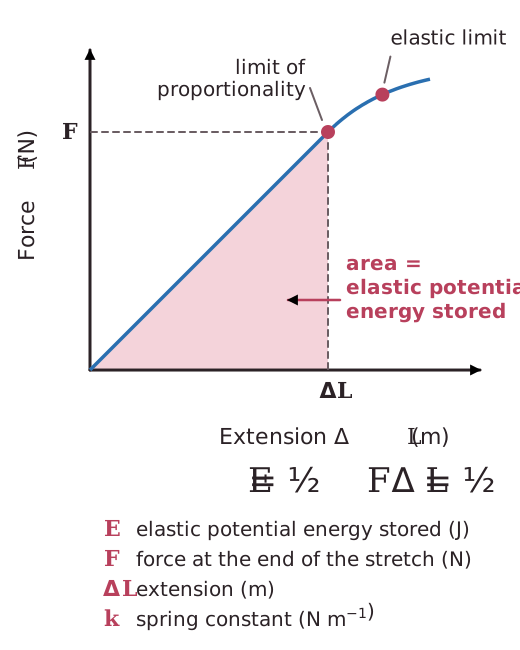
For a spring that obeys Hooke's law, the graph is a straight line and the area is a triangle, so the energy stored is E = ½FΔL. Since F = kΔL, this can also be written E = ½kΔL2.Because the energy depends on the square of the extension, doubling the extension stores four times as much energy. If the spring is stretched beyond its limit of proportionality, the energy is still the area under the curve, but the simple formulae no longer apply.
The Energy Stored in a Stretched Spring
Read the text
Read the text and highlight anything you think is important. When you go on, the text is hidden and you answer from memory.
Specification: AQA Physics (7407), AS-level, 3.4.2.1 Bulk properties of solids. Topic: Materials.
More in Materials
- The Density of Alloys
- Hooke's Law
- Springs in Parallel
- Springs in Series
- Tensile and Compressive Forces
- Tensile Stress
- Tensile Strain
- Young Modulus
All 18 lessons in Materials · All AQA AS-level Physics topics