Density is mass per unit volume, ρ = m/V, measured in kg m-3 or g cm-3. Measuring density therefore means measuring a mass and a volume.The mass of a solid is measured with a top-pan balance. For a regular solid such as a cube or cylinder, the volume is calculated from its dimensions, measured with a ruler, vernier callipers or a micrometer.For an irregular solid, the volume is found by displacement. The object is lowered into a displacement can or measuring cylinder of water, and the volume of water displaced equals the volume of the object.
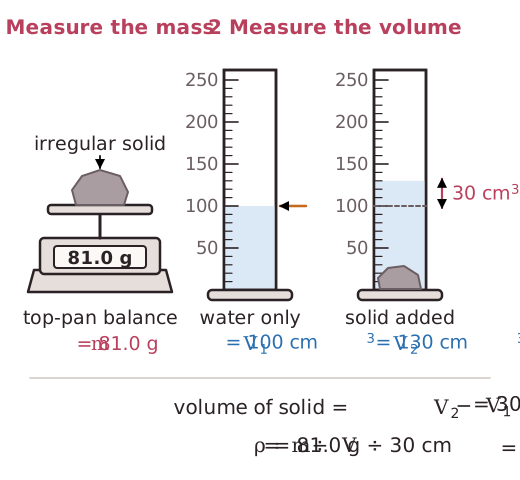
For a liquid, measure the mass of an empty measuring cylinder, pour in a known volume of the liquid, and measure the mass again. The difference gives the mass of the liquid.Once the mass and volume are known, divide the mass by the volume. Repeat the measurements and take a mean to reduce random errors, and read the measuring cylinder at eye level from the bottom of the meniscus.
Measuring Density
Read the text
Read the text and highlight anything you think is important. When you go on, the text is hidden and you answer from memory.
Specification: AQA Physics (7407), AS-level, 3.4.2.1 Bulk properties of solids. Topic: Materials.
More in Materials
- Density
- The Density of Alloys
- Hooke's Law
- Springs in Parallel
- Springs in Series
- The Energy Stored in a Stretched Spring
- Tensile and Compressive Forces
- Tensile Stress
All 18 lessons in Materials · All AQA AS-level Physics topics