When two springs are placed in parallel the effective spring constant is the sum of the two spring constants.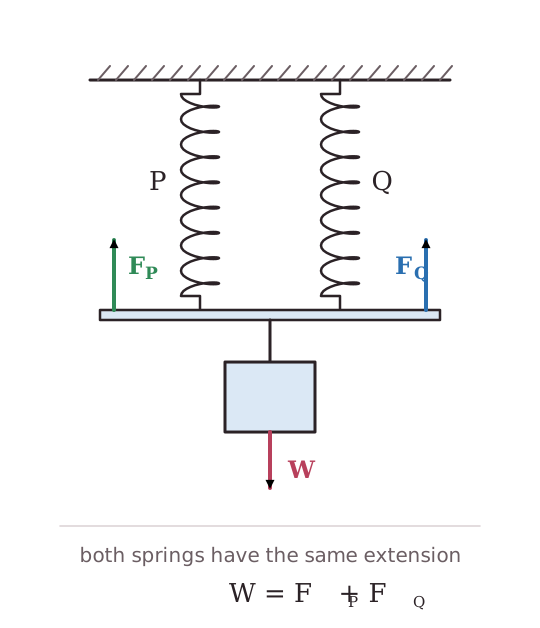 W = FP + FQW = kPΔL + kQΔLAs ΔL is the same, the effective spring constant k is given by:k = kP + kQIn parallel, the springs share the load and each spring has the same extension. Using Hooke's law, F = kΔL, the force on spring P is kPΔL and the force on spring Q is the total weight W minus the force on P.Two identical springs in parallel give double the stiffness of one spring. Each spring carries half the load, so the extension is halved.Worked example: springs P and Q have spring constants of 2000 N m-1 and 2500 N m-1. A load of 1950 N is hung from both.
k = 2000 + 2500 = 4500 N m-1 ΔL = 1950 / 4500 = 0.43 m The force on P is 2000 × 0.433 = 867 N and the force on Q is 2500 × 0.433 = 1083 N, which add up to 1950 N. The stiffer spring carries the larger share of the load.
W = FP + FQW = kPΔL + kQΔLAs ΔL is the same, the effective spring constant k is given by:k = kP + kQIn parallel, the springs share the load and each spring has the same extension. Using Hooke's law, F = kΔL, the force on spring P is kPΔL and the force on spring Q is the total weight W minus the force on P.Two identical springs in parallel give double the stiffness of one spring. Each spring carries half the load, so the extension is halved.Worked example: springs P and Q have spring constants of 2000 N m-1 and 2500 N m-1. A load of 1950 N is hung from both.