Skip to content

Rubber

Rubber is an elastic polymer that can be stretched to several times its original length and still return to that length when the load is removed.
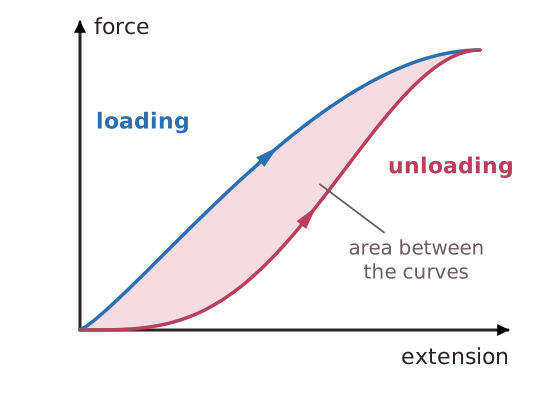
Rubber does not obey Hooke's law. Its limit of proportionality is very low, and the force-extension graph is curved: it is easy to stretch at first as the tangled polymer chains straighten, then becomes much stiffer once they are fully straightened.When the load is removed, the unloading curve lies below the loading curve, so the extension during unloading is greater than during loading for a given tension. As long as the elastic limit has not been exceeded, both curves meet at the origin and there is no permanent extension.The loop formed by the two curves is called a hysteresis loop. The area between the curves is the energy dissipated as heat inside the rubber, which is why a rubber band warms up when it is stretched and released repeatedly.

Read the text

Read the text and highlight anything you think is important. When you go on, the text is hidden and you answer from memory.

Specification: AQA Physics (7407), AS-level, 3.4.2.1 Bulk properties of solids. Topic: Materials.

Key terms in this lesson

Resistance
The ratio of the potential difference across a component to the current flowing through it, measured in ohms.

More in Materials

All 18 lessons in Materials · All AQA AS-level Physics topics