At equilibrium there is no resultant force and no resultant moment.Vector arrows for all forces in equilibrium placed tip to tail will form a closed loop.Three forces in equilibrium will form a triangle.Triangle of Forces:At equilibrium: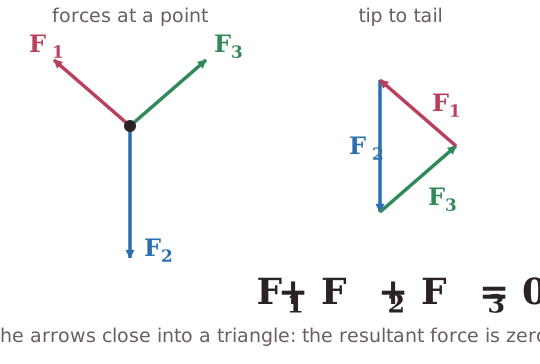 To use the triangle of forces, draw each force as a vector arrow to scale, in its correct direction, with the tip of one arrow joined to the tail of the next. The order does not matter. If the object is in equilibrium the arrows form a closed triangle, so the resultant force is zero.The unknown sides and angles can be found by scale drawing or by trigonometry. For example, if forces of 3.0 N and 4.0 N act at right angles, the third force needed for equilibrium is found using Pythagoras: √(3.02 + 4.02) = 5.0 N.For an object resting on a slope at angle θ, the three forces are the weight W, the normal reaction and the friction. The normal reaction is W cosθ and the friction is W sinθ, so the closed triangle is a right-angled triangle.If more than three forces act on an object in equilibrium, the arrows placed tip to tail form a closed polygon.