An X-ray tube is an evacuated glass tube containing a cathode and an anode.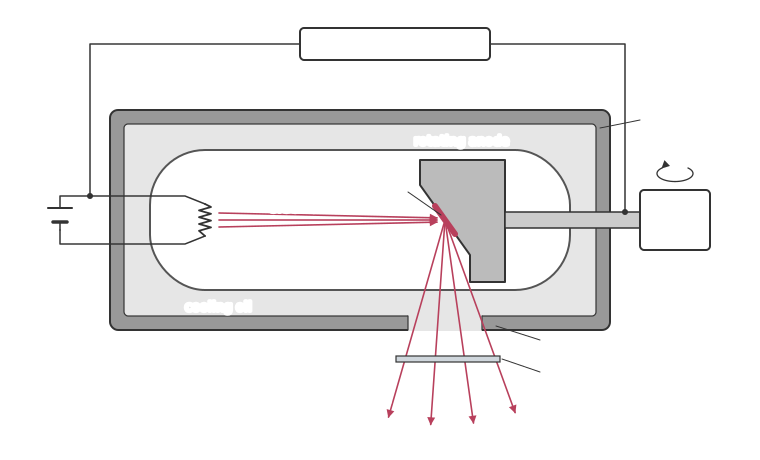
• High p.d.: tens of kilovolts (up to about 150 kV) between cathode and anode accelerates the electrons.
• Vacuum: electrons do not collide with gas molecules on the way.
• Target: usually tungsten, set into the anode, because it has a high melting point and a high proton number.
• Rotating anode and cooling oil: about 99% of the energy becomes heat, so the anode spins to spread the heat over a larger area of target and oil carries heat away.
• Lead casing and window: the lead absorbs stray X-rays; the beam leaves through a window.
• Aluminium filter: removes low-energy photons that would only be absorbed by the skin, adding dose without improving the image.The tube current controls how many electrons hit the target, so it controls the intensity of the beam. The accelerating p.d. controls the maximum photon energy, so it controls how penetrating the X-rays are.Worked example: a tube current of 5.0 mA means the number of electrons reaching the target each second isN = I / e = 5.0 × 10⁻³ / 1.60 × 10−19 = 3.1 × 10¹⁶ s−1 At 100 kV the input power is VI = 100 000 × 0.0050 = 500 W, and nearly all of it has to be removed as heat.
• High p.d.: tens of kilovolts (up to about 150 kV) between cathode and anode accelerates the electrons.
• Vacuum: electrons do not collide with gas molecules on the way.
• Target: usually tungsten, set into the anode, because it has a high melting point and a high proton number.
• Rotating anode and cooling oil: about 99% of the energy becomes heat, so the anode spins to spread the heat over a larger area of target and oil carries heat away.
• Lead casing and window: the lead absorbs stray X-rays; the beam leaves through a window.
• Aluminium filter: removes low-energy photons that would only be absorbed by the skin, adding dose without improving the image.The tube current controls how many electrons hit the target, so it controls the intensity of the beam. The accelerating p.d. controls the maximum photon energy, so it controls how penetrating the X-rays are.Worked example: a tube current of 5.0 mA means the number of electrons reaching the target each second is