As a parallel X-ray beam passes through a material, its intensity decreases exponentially with thickness:I = I0 e−μx I0 is the incident intensity, I the transmitted intensity, x the thickness and μ the attenuation (absorption) coefficient. μ has units of m−1, or cm−1 or mm−1 when x is in those units. Always use the same length unit for μ and x.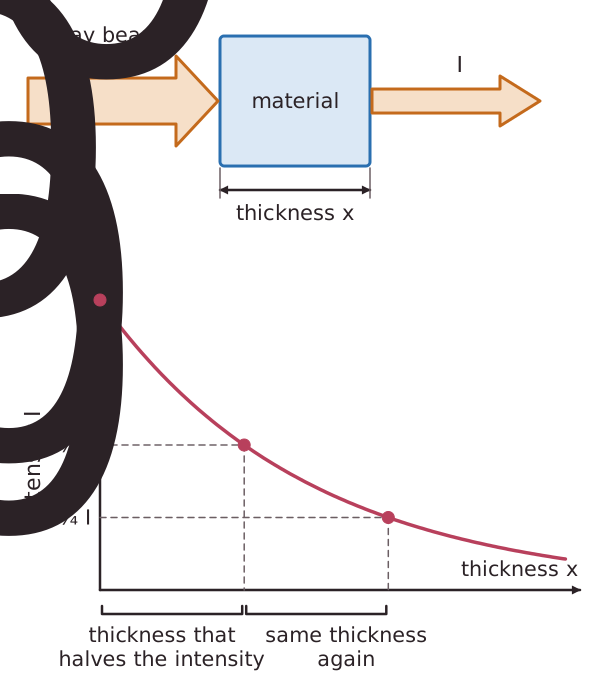 μ depends on the material and on the photon energy. Bone has a much larger μ than soft tissue, so less X-radiation passes through it. Fewer photons reach the detector behind bone, so bone appears white on an X-ray image and soft tissue appears darker.The half-value thickness x½ is the thickness that halves the intensity. Putting I = I0/2 into the equation gives
x½ = ln 2 / μ Worked example: μ = 0.25 cm−1 and x = 4.0 cm. Find the fraction transmitted and the half-value thickness.I/I0 = e−0.25 × 4.0 = e−1.0 = 0.37
x½ = 0.693 / 0.25 = 2.8 cm So 37% of the intensity gets through. Each extra 2.8 cm of this material would halve the transmitted intensity again.
μ depends on the material and on the photon energy. Bone has a much larger μ than soft tissue, so less X-radiation passes through it. Fewer photons reach the detector behind bone, so bone appears white on an X-ray image and soft tissue appears darker.The half-value thickness x½ is the thickness that halves the intensity. Putting I = I0/2 into the equation gives