A CAT scan (computerised axial tomography, also called a CT scan) uses X-rays to build up images of thin slices through the body.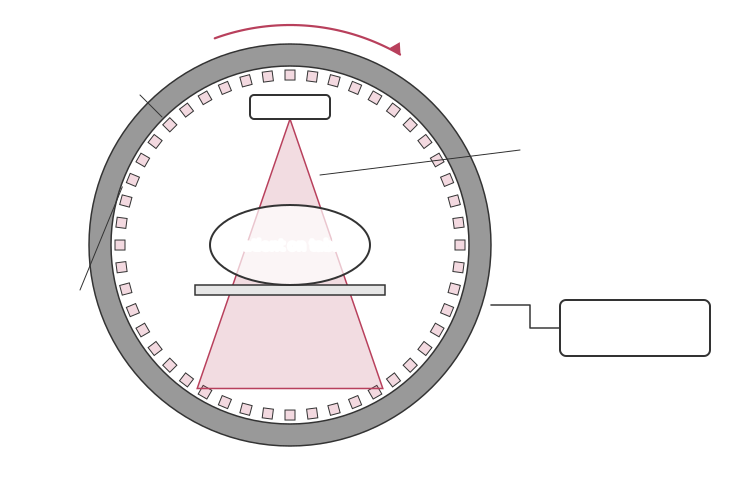
• an X-ray tube that rotates around the patient, producing a thin fan-shaped beam
• a ring of detectors on the opposite side that measures the intensity of X-rays passing through the body along many different lines
• a computer and display that process the readingsAs the tube rotates, the detectors record the attenuation from hundreds of directions. The computer combines these readings to work out the attenuation at every point in a slice through the patient. Moving the table and scanning again gives many slices, which the computer stacks into a three-dimensional (3D) image.Advantages over a simple X-ray image:
• it gives a 3D image that can be rotated and viewed from any angle, or cut into any slice
• it can show soft tissues with only small differences in attenuation coefficient, such as the brain
• organs are not hidden behind one another, as they are on a flat X-rayDisadvantages: the patient receives a much larger radiation dose, the scanner is expensive, and the patient must keep still for the whole scan.