X-rays are high-energy electromagnetic photons. In a hospital they are made when fast-moving electrons are rapidly decelerated by a metal target.Electrons are accelerated through a potential difference V, so each gains kinetic energy eV. When an electron slows down suddenly near the nuclei of the target, it loses kinetic energy as X-ray photons (braking radiation). One electron may lose its energy in several steps, so a continuous range of photon energies is produced. A few sharp peaks are added where electrons knock out inner electrons of the target atoms.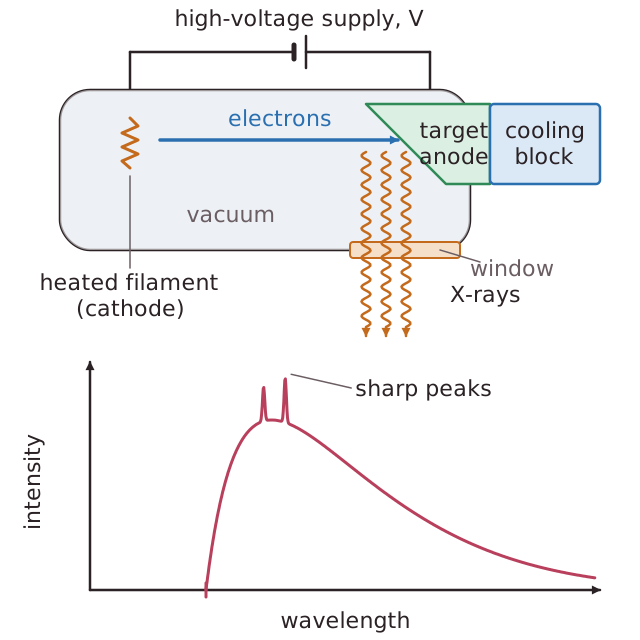 The maximum photon energy occurs when an electron loses all of its kinetic energy in one photon:
hfmax = eV so λmin = hc / eV The process is very inefficient: only about 1% of the electrons' kinetic energy becomes X-rays. The other 99% heats the target.Worked example: the accelerating p.d. is 80 kV. Find the maximum photon energy and the minimum wavelength.Emax = eV = 1.60 × 10−19 × 80 000 = 1.28 × 10⁻¹⁴ J (80 keV)
λmin = (6.63 × 10−34 × 3.00 × 108) / 1.28 × 10−14 = 1.55 × 10⁻¹¹ m A higher accelerating p.d. gives higher-energy, more penetrating X-rays with a shorter minimum wavelength. Note that the maximum photon energy in keV has the same number as the accelerating p.d. in kV.
The maximum photon energy occurs when an electron loses all of its kinetic energy in one photon: