The angular speed ω of an object moving in a circle is the angle swept out by the radius per unit time, ω = Δθ/Δt. It is measured in radians per second (rad s-1).In one complete revolution the object turns through 2π radians in one period T, so ω = 2π/T. Since the frequency f = 1/T, this can also be written as ω = 2πf.
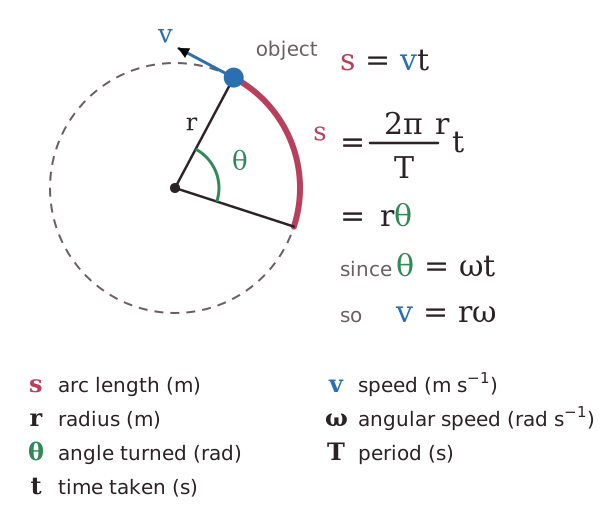
Angular speed is linked to the linear speed v along the circle. In a time Δt the object moves an arc length Δs = rΔθ, so v = rω. Every point on a rotating wheel has the same angular speed, but points further from the axle move with a greater linear speed.For example, a wheel turning 5 times per second has ω = 2π × 5 = 10π rad s-1. A point on its rim, 0.5 m from the centre, moves at v = 0.5 × 10π = 15.7 m s-1.
Angular Speed
Read the text
Read the text and highlight anything you think is important. When you go on, the text is hidden and you answer from memory.
Specification: OCR Physics A (H556), A-level, 5.2.1 Kinematics of circular motion. Topic: Circular Motion.
Key terms in this lesson
- gravitational field
- A region of space in which a mass experiences a force due to the presence of another mass.
More in Circular Motion
- Uniform Circular Motion
- Angular Displacement
- Centripetal Acceleration
- Proof - centripetal acceleration
- Centripetal Force
- On the Road
- The London Eye
- A Spin Dryer
All 9 lessons in Circular Motion · All OCR A-level Physics topics