 BRAINCAKE
Simple Harmonic Motion and Circular Motion
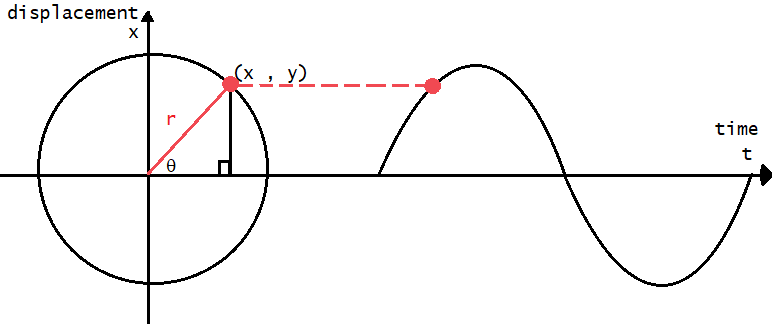
Consider an object going round in a circle at uniform speed. The y co-ordinate oscillates between the top and bottom of the circle and is always equal to the radius multiplied by the sine of the angle between the point and the x axis, θ. If the object travels with uniform circular motion, the acceleration = -v2/r = -(2πf)2r.