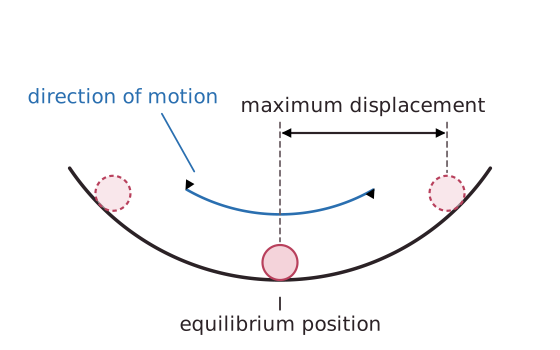
An oscillating object moves repeatedly one way and then in the opposite direction through its equilibrium position. The displacement of the object decreases as it approaches the equilibrium position then reverses and increases as it moves away from the equilibrium position.The amplitude is the maximum displacement. If the amplitude is constant and there are no frictional forces present, the oscillations are free oscillations. The time period T is the time for one complete cycle of oscillations, the frequency f is the number of oscillations per second and the angular frequency ω is given by ω = 2π/T.