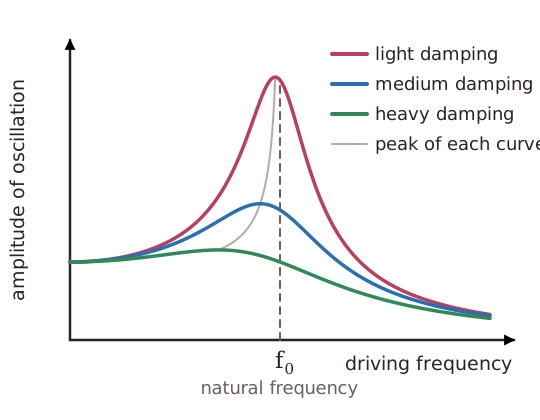
When a periodic force is applied to a system, the system undergoes forced oscillations. When the forcing frequency is equal to the natural frequency of the system, the amplitude of the oscillations becomes very large, and the periodic force is in phase with the velocity of the oscillating object and π/2 outof phase with the displacement.
Resonance
Read the text
Read the text and highlight anything you think is important. When you go on, the text is hidden and you answer from memory.
Specification: Edexcel Physics (9PH0), A-level, Topic 13: Oscillations, statements 189 and 190. Topic: Simple Harmonic Motion.
Key terms in this lesson
- red giant
- A cool, highly luminous, greatly expanded star formed when a low-mass star's core contracts and hydrogen fuses in a shell around it.
- planetary nebula
- The expanding shell of gas ejected by a low-mass star as it evolves from a red giant into a white dwarf.
- supernova
- A violent explosion marking the end of a high-mass star's life, briefly outshining a whole galaxy and scattering heavy elements into space.
- neutron star
- The extremely dense remnant of a supernova, made almost entirely of neutrons, left when a collapsing core is too massive to form a white dwarf.
- black hole
- A region of space where gravity is so strong that the escape velocity exceeds the speed of light, so nothing can escape.
More in Simple Harmonic Motion
- Oscillations
- Phase Difference
- Simple Harmonic Motion
- Simple Harmonic Motion and Circular Motion
- Mass-Spring System
- A Simple Pendulum
- Energy and Simple Harmonic Motion
- Damping
All 9 lessons in Simple Harmonic Motion · All Edexcel A-level Physics topics