Skip to content

Energy and Simple Harmonic Motion

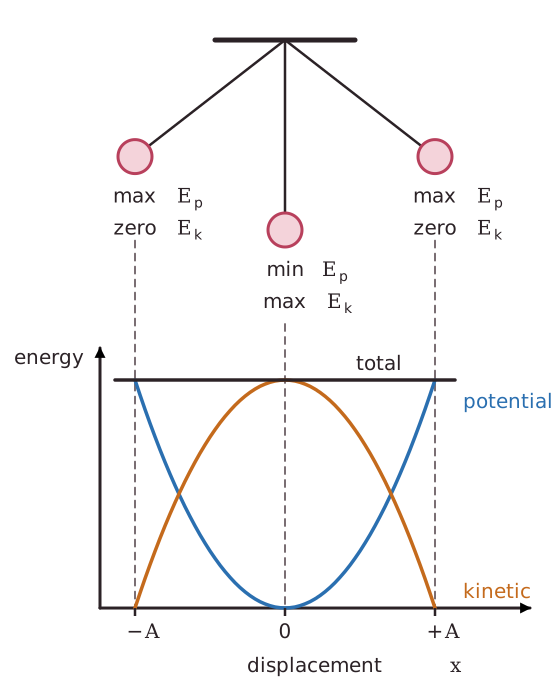
A freely oscillating object oscillates with contant amplitude as there are no frictional forces acting upon it. The only force acting on it is the restoring force. Consider the transfers of energy of a simple pendulum. At the highest point, the kinetic energy is zero as the velocity is zeroand the gravitational potential energy is a maximum. At the lowest point (equilibrium position) all the gravitational potential energy has been transferred to kinetic energy. As it rises, the kinetic energy is transferred to gravitational potential energy again.Using EP = ½kA2 where k is the spring constant and the amplitude A has been substituted for x, the kinetic energy is given byEk=Etotal - EP = ½mv2 = ½k(A2 - x2)
Read the text

Read the text and highlight anything you think is important. When you go on, the text is hidden and you answer from memory.

Specification: Edexcel Physics (9PH0), A-level, Topic 13: Oscillations, statements 181 and 183. Topic: Simple Harmonic Motion.

Key terms in this lesson

main sequence
The stable, longest stage of a star's life in which it fuses hydrogen into helium in its core, forming a diagonal band on the Hertzsprung-Russell diagram.
red giant
A cool, highly luminous, greatly expanded star formed when a low-mass star's core contracts and hydrogen fuses in a shell around it.
red supergiant
A very large, extremely luminous, cool star formed when a high-mass star's outer layers swell as its core fuses progressively heavier elements.
white dwarf
The small, extremely dense, hot core left behind after a low-mass star sheds its outer layers, no longer undergoing fusion.

More in Simple Harmonic Motion

All 9 lessons in Simple Harmonic Motion · All Edexcel A-level Physics topics