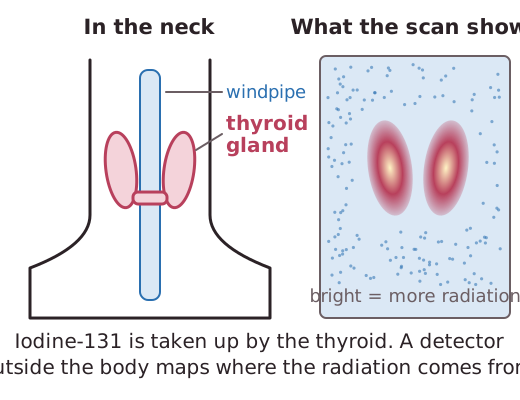
A radioactive tracer can be used to trace the path of movement of a substance through some system e.g. the movement of blood through blood vessels, food through the digestive system, water through a system of pipes.In order to do this, the source must have a half-life long enough for it to be detected while the test is carried out, but short enough for it to decay to a safe level soon after use.Tritiated water has a half-life of 12 years and is a β-emitter. This can be used to detect leaks from underground pipes or force through oil reservoirs to model oil recovery.Phosphorus-32 is a beta emitter with a half-life of 14 days. This can be used to measure the uptake of fertilisers by plants.Iodine-131 is a beta emitter with a half-life of 8 days. This can be used to check the activity of the thyroid gland.