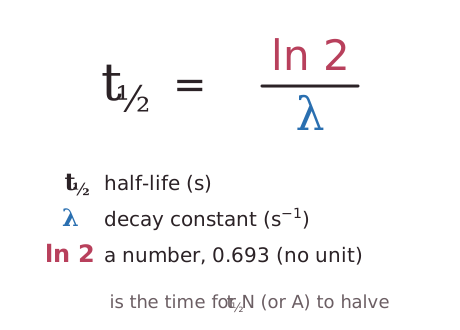
The decay constant λ is the probability that an individual nucleus will decay per unit time. Its unit is s-1, although h-1 or year-1 can be used for long-lived isotopes.Radioactive decay is random, so it is impossible to predict when a particular nucleus will decay. For a large number N of undecayed nuclei, however, the number decaying per second is proportional to N. The activity is therefore A = λN, measured in becquerels (Bq), where 1 Bq is one decay per second.Because the rate of decay is proportional to the number of nuclei remaining, N falls exponentially with time: N = N0e-λt. The activity follows the same pattern, A = A0e-λt.The half-life T½ is the time taken for the number of undecayed nuclei, or the activity, to fall to half. Substituting N = ½N0 into the exponential equation gives T½ = ln 2 / λ, so an isotope with a large decay constant has a short half-life.