 BRAINCAKE
Argon dating
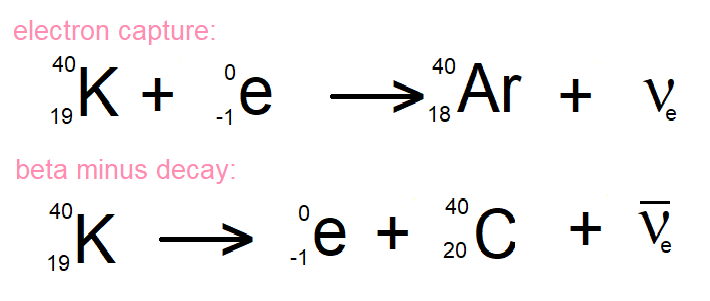
The radioactive isotope of potassium in ancient rocks decays into argon gas which becomes trapped in the rocks.
This occurs as a result of electron capture when an inner shell electron is captured by the nucleus.
A proton turns into a neutron and a neutrino is emitted.
Sign in free to see the rest of this lesson, the R.E.C.I.P.E. recall steps and the quiz
BrainCake is free. Make an account in seconds and pick up where this page stops.
Key terms in this lesson
- Half-life
- The average time taken for the activity, or the number of undecayed nuclei, of a radioactive isotope to decrease to half its initial value.
More in Radioactivity
- Activity
- Radioactive Decay
- Decay Constant
- Radiocarbon dating
- Radioactive Tracers
- Thickness Monitoring and Engine Wear
- Power Sources
- N-Z Graph
All 25 lessons in Radioactivity · All AQA A-level Physics topics