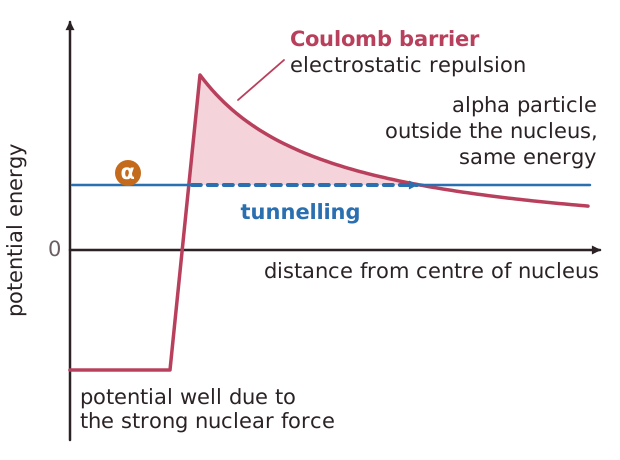
In the nucleus, neutrons and protons are bound together by the strong nuclear force. The strong nuclear force makes it difficult to remove a nucleon. The electrostatic force of repulsion makes it difficult to add a proton.Clusters of neutrons and protons can form within a very large nucleus. If a cluster of 2 neutrons and 2 protons forms the binding energy is large (7MeV per nucleon) compared to other clusters and the alpha particle formed gains kinetic energy equal to the binding energy. This energy is not sufficient to leave the nucleus.The Coulomb barrier is the electrostatic force of repulsion in the nucleus. The potential well is due to the strong nuclear force it needs to overcome to leave the nucleus.However, if you consider the wave properties of matter, the alpha particles position can be calculated from the probability that the alpha particle is in any one place. There is therefore a small, non-zero probability that the alpha-particle can be positioned outside the nucleus i.e. it can tunnel through the potential energy barrier without gaining any extra energy.