 BRAINCAKE
Binding Energy and Nuclear Stability
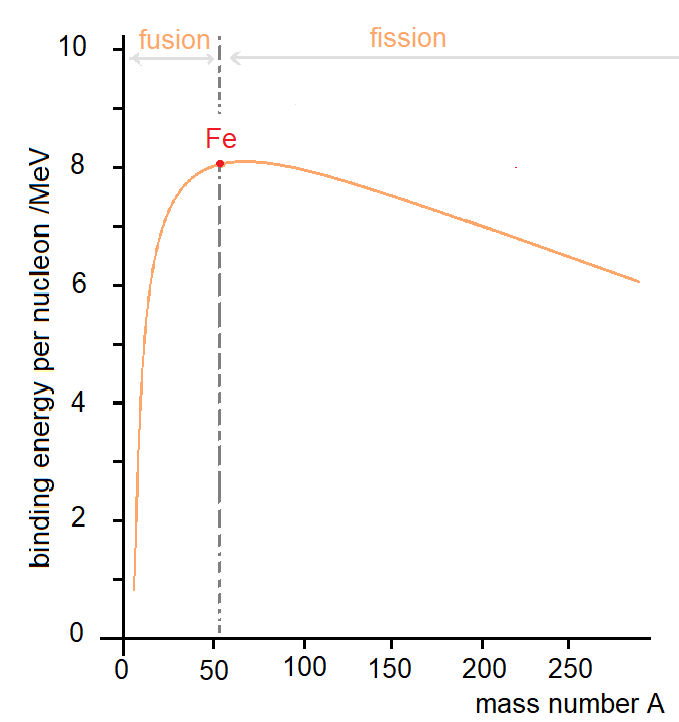
When bonds are formed between nucleons, the energy released is called the binding energy. This means that the mass of the nucleus is less than the mass of the separate nucleons. The relationship between this mass difference or mass defect is that energy released:
E = Δmc2
The mass defect Δm of a nucleus is the difference between the mass of the separate nucleons and the mass of the nucleus.
Sign in free to see the rest of this lesson, the R.E.C.I.P.E. recall steps and the quiz
BrainCake is free. Make an account in seconds and pick up where this page stops.
Key terms in this lesson
- Nuclear fission
- The splitting of a large, unstable nucleus into two smaller nuclei, plus neutrons, releasing energy because the products are more tightly bound than the original nucleus.
- Nuclear fusion
- The joining of two light nuclei to form a heavier nucleus, releasing energy provided the mass number of the product is less than about 56.
More in Nuclear Energy
- Mass-Energy Equivalence
- Strong Nuclear Force
- Quantum Tunnelling
- Nuclear Fission
- Nuclear Fusion
- Nuclear Reactors
- Safety
All 8 lessons in Nuclear Energy · All AQA A-level Physics topics