A power station alternator (a.c. generator) is made of 3 sets of stationary coils (stator) at 120° to each other and a rotor - an electromagnet that spins in the middle of the coil. The electromagnet is connected to a d.c. supply and induces an alternating e.m.f. in each of the coils. The three e.m.fs are out of phase with each other by 120°.
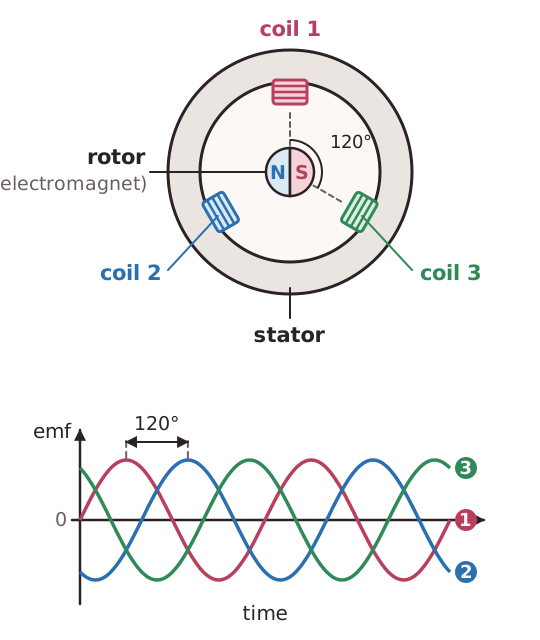
Power Station Alternators
Read the text
Read the text and highlight anything you think is important. When you go on, the text is hidden and you answer from memory.
Specification: AQA Physics (7408), A-level, 3.7.5.4 Electromagnetic induction and 3.7.5.3 Magnetic flux and flux linkage. Topic: Electromagnetic Induction.
Key terms in this lesson
- Nuclear fission
- The splitting of a large, unstable nucleus into two smaller nuclei, plus neutrons, releasing energy because the products are more tightly bound than the original nucleus.
More in Electromagnetic Induction
- Solenoid
- Lenz's Law
- Faraday's Law of Electromagnetic Induction
- The Alternating Current Generator
- Back e.m.f.
- Transformers
- Transformer Efficiency
- The National Grid
All 12 lessons in Electromagnetic Induction · All AQA A-level Physics topics