Skip to content

Lenz's Law

The direction of an induced current is given by Lenz's law: the induced current always flows in a direction that opposes the change that produced it.When the north pole of a bar magnet is pushed into a coil, the induced current makes the end of the coil nearest the magnet a north pole. This repels the incoming magnet, so work has to be done to push it in. When the magnet is pulled out, the current reverses and that end becomes a south pole, which attracts the magnet and opposes its removal.
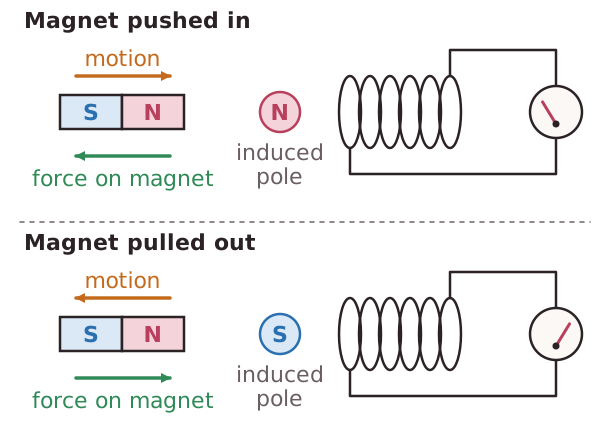
Lenz's law is a consequence of the conservation of energy. If the induced current helped the change, the magnet would be pulled in faster and faster and electrical energy would be created from nothing. Instead, the work done against the opposing force is what is transferred to electrical energy in the circuit.The same idea explains electromagnetic braking. A magnet dropped through a coil connected in a closed circuit, or through a copper tube, falls more slowly than in free fall because the induced current produces a force that opposes its motion. If the circuit is open, an emf is still induced but no current flows, so there is no opposing force.To find the direction of an induced current, decide how the magnetic flux through the circuit is changing, then choose the current direction whose own magnetic field opposes that change. The right-hand grip rule gives the field of a coil, and Fleming's right-hand rule gives the current in a moving straight conductor.

Read the text

Read the text and highlight anything you think is important. When you go on, the text is hidden and you answer from memory.

Specification: AQA Physics (7408), A-level, 3.7.5.4 Electromagnetic induction. Topic: Electromagnetic Induction.

Key terms in this lesson

Binding energy
The energy needed to completely separate a nucleus into its individual, unbound protons and neutrons.

More in Electromagnetic Induction

All 12 lessons in Electromagnetic Induction · All AQA A-level Physics topics