A capacitor can be charged by connecting it to a source of constant potential difference.At any one instance the source is equal to the potential difference across both the capacitor and resistor. As the capacitor becomes charged, its p.d. increases until no more current flows in the circuit and the capacitors p.d. is equal to the source p.d. The current decreases exponentially to zero.
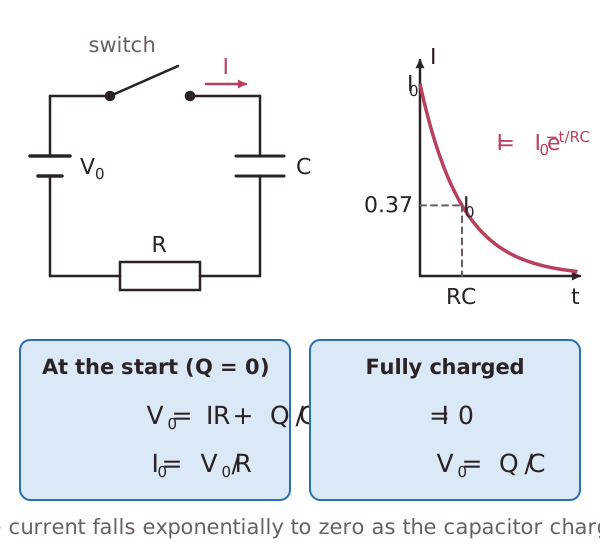
Charging a Capacitor through a fixed resistor
Read the text
Read the text and highlight anything you think is important. When you go on, the text is hidden and you answer from memory.
Specification: AQA Physics (7408), A-level, 3.7.4.4 Capacitor charge and discharge. Topic: Capacitors.
More in Capacitors
- Use of Capacitors
- Energy Stored in a Charged Capacitor
- Measuring the Energy Stored in a Charged Capacitor.
- Energy stored in a Thundercloud
- Discharging a Capacitor through a Fixed Resistor
- Exponential Decay.
- The Time Constant RC
- Measurement with Oscilloscope. Capacitor Smoothing
All 12 lessons in Capacitors · All AQA A-level Physics topics