 BRAINCAKE
Refracting Telescopes
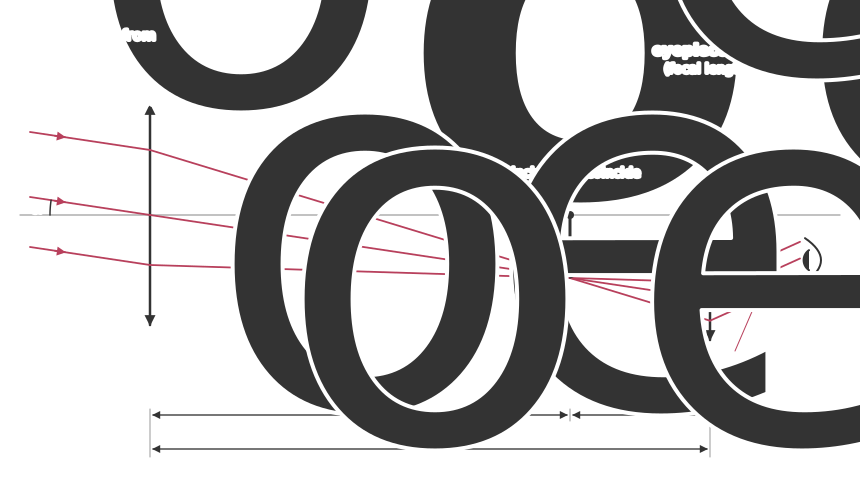
An astronomical refracting telescope uses two converging lenses:
• the objective lens, with a long focal length fo, collects light from the distant object
• the eyepiece lens, with a short focal length fe, acts as a magnifying glass
Light from a very distant object arrives as parallel rays. The objective forms a real, inverted image at its principal focus. The eyepiece is placed so that this image is also at the eyepiece's principal focus.
In normal adjustment the principal foci of the two lenses coincide, so:
• the distance between the lenses is fo + fe
Sign in free to see the rest of this lesson, the R.E.C.I.P.E. recall steps and the quiz
BrainCake is free. Make an account in seconds and pick up where this page stops.
Key terms in this lesson
- principal focus
- The point on the axis of a lens or mirror at which rays parallel to the axis converge, or from which they appear to diverge, after refraction or reflection.
More in Astrophysics
- Angular Magnification
- Reflecting Telescopes
- Chromatic and Spherical Aberration
- Resolving Power
- Radio Telescopes
- Charge-Coupled Devices
- Apparent Magnitude
- Parsecs and Light Years
All 24 lessons in Astrophysics · All AQA A-level Physics topics