 BRAINCAKE
Reflecting Telescopes
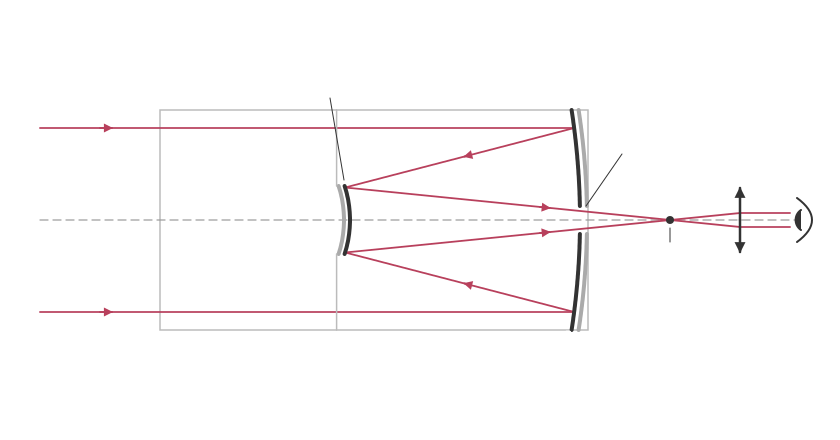
A reflecting telescope uses a large concave mirror, instead of a lens, as its objective. The arrangement you need to know is the Cassegrain arrangement:
• a large concave parabolic primary mirror with a hole in its centre collects the light
• a small convex secondary mirror reflects the light back towards the primary
• the light passes through the hole in the primary and is focused just behind it, where an eyepiece (or camera) is placed
Sign in free to see the rest of this lesson, the R.E.C.I.P.E. recall steps and the quiz
BrainCake is free. Make an account in seconds and pick up where this page stops.
Key terms in this lesson
- chromatic aberration
- A fault in an image formed by a lens in which different wavelengths of light are refracted by different amounts, producing coloured fringes and a blurred image.
- diffraction
- The spreading out of a wave as it passes through a gap or travels round an obstacle.
More in Astrophysics
- Refracting Telescopes
- Angular Magnification
- Chromatic and Spherical Aberration
- Resolving Power
- Radio Telescopes
- Charge-Coupled Devices
- Apparent Magnitude
- Parsecs and Light Years
All 24 lessons in Astrophysics · All AQA A-level Physics topics