 BRAINCAKE
Chromatic and Spherical Aberration
Real lenses and mirrors do not bring all rays to a single perfect focus. Two faults, called aberrations, blur the image.
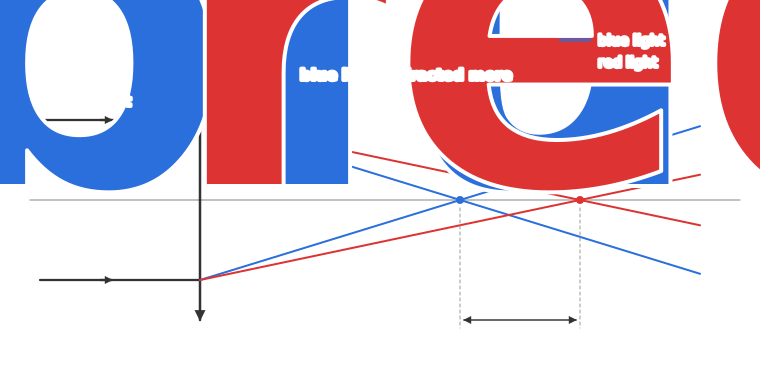
Chromatic aberration happens in lenses. The refractive index of glass depends on the wavelength of light, so different colours are refracted by different amounts. Blue light is refracted more than red light, so a converging lens brings blue light to a focus closer to the lens than red light. There is no single focal point, so the image is blurred and has coloured fringes.
Sign in free to see the rest of this lesson, the R.E.C.I.P.E. recall steps and the quiz
BrainCake is free. Make an account in seconds and pick up where this page stops.
More in Astrophysics
- Refracting Telescopes
- Angular Magnification
- Reflecting Telescopes
- Resolving Power
- Radio Telescopes
- Charge-Coupled Devices
- Apparent Magnitude
- Parsecs and Light Years
All 24 lessons in Astrophysics · All AQA A-level Physics topics