Distances in astronomy are so large that metres are inconvenient, so two other units are used.The light year (ly) is the distance travelled by light in a vacuum in one year:
1 ly = 3.00 × 108 × 3.15 × 107 ≈ 9.46 × 10¹⁵ mThe astronomical unit (AU) is the mean distance from the Earth to the Sun, 1 AU = 1.50 × 10¹¹ m.The parsec (pc) is the distance at which 1 AU subtends an angle of 1 arcsecond (1/3600 of a degree):1 pc = 3.08 × 10¹⁶ m ≈ 3.26 ly The parsec comes from stellar parallax. As the Earth orbits the Sun, a nearby star appears to move against the background of very distant stars. The parallax angle, p, is the angle subtended at the star by 1 AU. Because the angles are tiny:d (in pc) = 1 / p (in arcseconds) 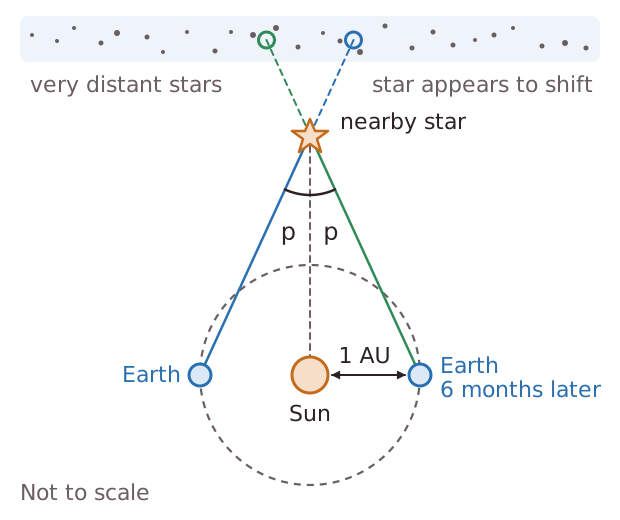 Worked example: a star has a parallax angle of 0.25 arcseconds.
d = 1 / 0.25 = 4.0 pc
In metres: 4.0 × 3.08 × 1016 = 1.2 × 10¹⁷ m
In light years: 4.0 × 3.26 ≈ 13 lyLarger distances are given in kiloparsecs (kpc) and megaparsecs (Mpc). The nearest star to the Sun is about 1.3 pc away.
1 ly = 3.00 × 108 × 3.15 × 107 ≈ 9.46 × 10¹⁵ mThe astronomical unit (AU) is the mean distance from the Earth to the Sun, 1 AU = 1.50 × 10¹¹ m.The parsec (pc) is the distance at which 1 AU subtends an angle of 1 arcsecond (1/3600 of a degree):
Worked example: a star has a parallax angle of 0.25 arcseconds.d = 1 / 0.25 = 4.0 pc
In metres: 4.0 × 3.08 × 1016 = 1.2 × 10¹⁷ m
In light years: 4.0 × 3.26 ≈ 13 lyLarger distances are given in kiloparsecs (kpc) and megaparsecs (Mpc). The nearest star to the Sun is about 1.3 pc away.