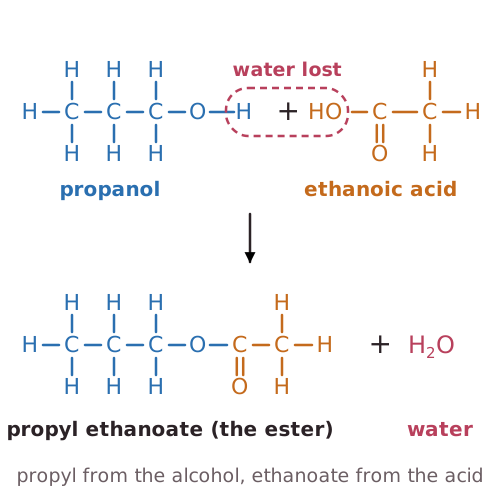
Esters are formed from the reaction of carboxylic acids and alcohols in the presence of a strong acid catalyst. Concentrated sulfuric acid is used as a catalyst and the reaction is known as esterification. The reaction is a condensation reaction. A molecule of water is removed to join the acid and alcohol together. A better yield can be obtained by gently heating acid anhydrides with alcoholsHydrolysis is the reverse of condensation. A molecule of water is added to break the ester bond. In acid hydrolysis the ester is heated under reflux with dilute sulfuric or hydrochloric acid. The sulfuric acid acts as a catalyst and the carboxylic acid and alcohol are formed. In alkaline hydrolysis aqueous sodium or potassium hydroxide is used. The carboxylate salt is formed with the alcohol instead of the acid.