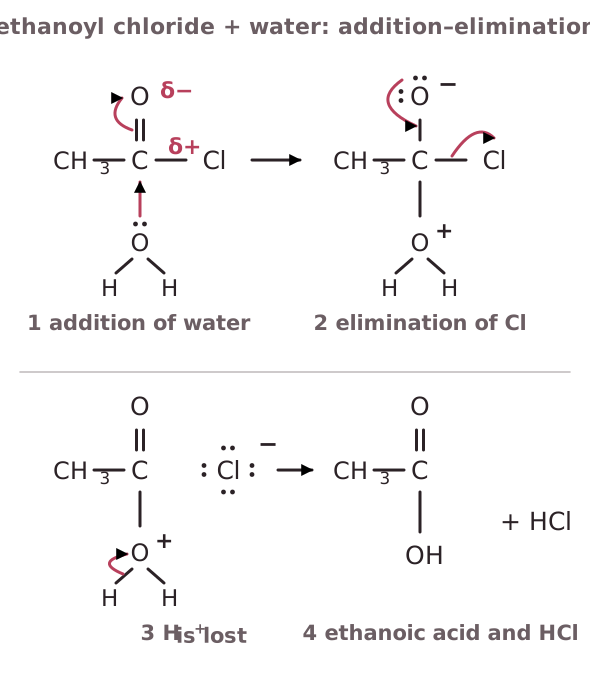
Acyl chlorides are carboxylic acid derivatives. Ethanoyl chloride CH3COCl can be prepared by reacting ethanoic acid with phosphorus V chloride - PCl5, phosphorus III chloride - PCl3 or thionyl chloride - SOCl2. The acyl chloride can be separated by fractional distillation.PCl5 + CH3COOH → CH3COCl + POCl3 + HClSOCl2 + CH3COOH → CH3COCl + SO2 + HClPCl3 + 3CH3COOH → 3CH3COCl + H3PO3Hydrolysis of acyl chlorides produces the corresponding carboxylic acid. The carbonyl group reacts with nucleophiles in an addition-elimination reaction.
Acyl Chlorides
Read the text
Read the text and highlight anything you think is important. When you go on, the text is hidden and you answer from memory.
Specification: OCR Chemistry A (H432), A-level, 6.1.3 Carboxylic acids and esters. Topic: Carbonyl Compounds.
Key terms in this lesson
- hydrolysis
- The breaking of a covalent bond by reaction with water, or with hydroxide ions in alkaline hydrolysis.
More in Carbonyl Compounds
- Reaction with Hydrogen Cyanide
- Silver Mirror Test
- 2,4-DNP Test for Carbonyl Compounds
- Carboxylic Acids
- Esters
- Fats and Oils
- Health
- Biodiesel
All 12 lessons in Carbonyl Compounds · All OCR A-level Organic Chemistry topics