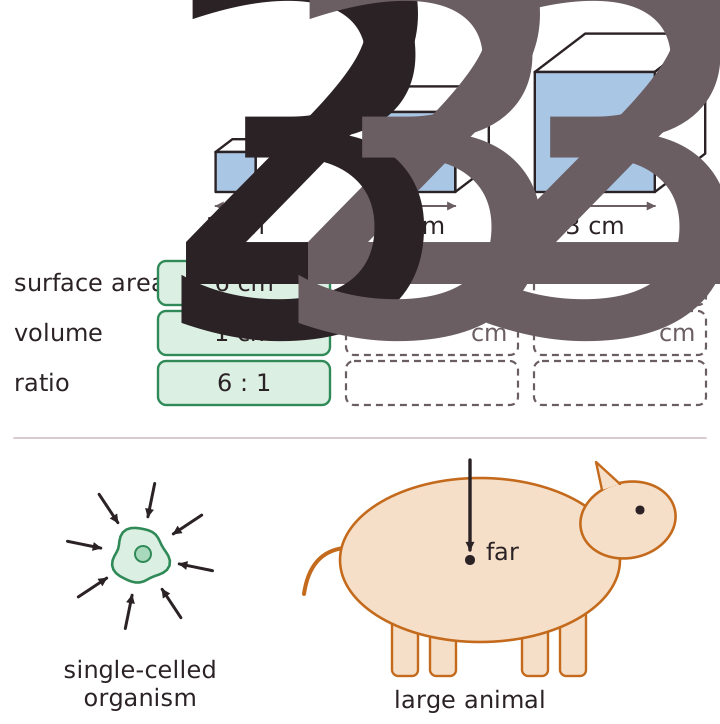
A single-celled organism is so small that it has a large surface area compared with its volume. Oxygen and food molecules can diffuse across the cell surface and reach every part of the cell quickly, and waste can diffuse out just as fast.
You can compare sizes by calculating the surface area to volume ratio. For a cube, surface area = 6 × (side length)2 and volume = (side length)3. A 1 cm cube has a surface area of 6 cm2 and a volume of 1 cm3, so the ratio is 6 : 1. Doubling the side length of a cube makes its volume 8 times bigger, but its surface area only 4 times bigger. A 3 cm cube has a surface area of 54 cm2 and a volume of 27 cm3, so the ratio is 2 : 1.
As an organism gets bigger, its volume increases faster than its surface area, so the surface area to volume ratio decreases. A large multicellular organism has a small surface area to volume ratio and the cells in the middle are a long way from the outside, so the diffusion distance is large. Diffusion alone is far too slow to supply them.
Multicellular organisms solve this with exchange surfaces, such as the lungs and the villi of the small intestine, which give a large surface area, and with a transport system, such as the blood, which carries substances to and from every cell.
Practical: cubes of gelatine containing alkali and the indicator phenolphthalein are pink. When they are placed in dilute hydrochloric acid, the acid diffuses in and the pink colour disappears. Small cubes, which have a larger surface area to volume ratio, lose their colour faster than big cubes.