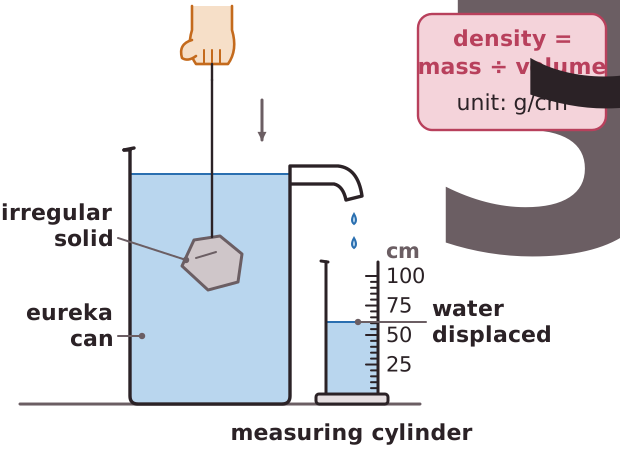
Density tells us how much mass a material has in each unit of volume. It is calculated with the equation density = mass ÷ volume. In symbols, ρ = m ÷ V. Density is measured in kg/m3 or g/cm3. Water has a density of 1 g/cm3, which is 1000 kg/m3.
Worked example: a block has a mass of 54 g and a volume of 20 cm3. Its density is 54 ÷ 20 = 2.7 g/cm3.
To measure density, first find the mass with a balance. For a regular solid, measure the length, width and height with a ruler and multiply them to get the volume. For an irregular solid, lower it into a eureka can full of water. The solid displaces its own volume of water, and the volume of water that flows out is measured in a measuring cylinder. For a liquid, measure the mass of a measuring cylinder with and without the liquid in it, and read the volume from the scale.
If the same mass takes up a bigger volume, the material has a lower density.