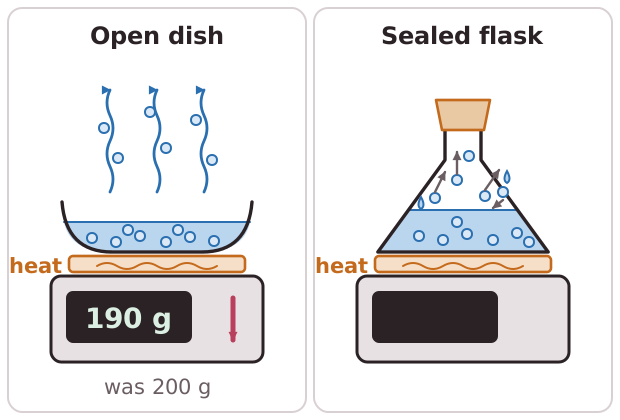
Melting, freezing, evaporation, condensation and sublimation are all changes of state. In every one of them the particles only change how they are arranged and how much energy they have. No particles are made or destroyed, so the number of particles stays the same and the mass is conserved.
Melting turns a solid into a liquid and freezing is the reverse. Evaporating turns a liquid into a gas and condensing is the reverse. In sublimation a solid turns straight into a gas without becoming a liquid first, as dry ice (solid carbon dioxide) does.
Mass can seem to disappear if the vapour escapes. Water left in an open dish evaporates and the measured mass appears to decrease, because the vapour spreads into the air. In a sealed flask holding 250 g of water, heating makes some of it evaporate but the total mass is still 250 g. In distillation, the mass of the liquid collected plus the mass left behind equals the mass you started with.