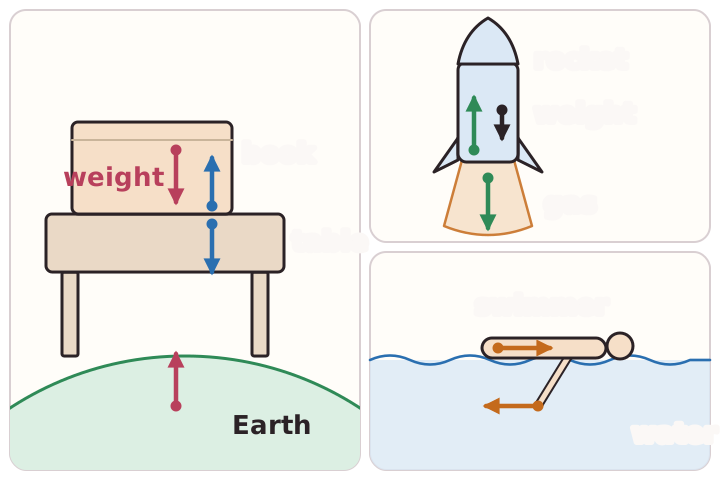
Newton's Third Law says that when object A exerts a force on object B, object B exerts a force on object A that is equal in size and opposite in direction. The two forces in a pair act on different objects, and they are always the same type of force (for example both contact forces or both gravitational forces).
A book at rest on a table is in equilibrium. Its weight acts downwards and the table pushes it upwards, and these two forces are balanced, so the resultant force is zero. These two forces are not a Newton's Third Law pair, because they both act on the book. The real pairs are: the Earth pulls the book down and the book pulls the Earth up, and the table pushes the book up while the book pushes the table down.
Situations that are not in equilibrium also follow the law. A rocket pushes hot exhaust gases backwards, and the gases push the rocket forwards with an equal force. A swimmer pushes the water backwards, and the water pushes the swimmer forwards. The pair of forces are always equal, but each acts on a different object, so the forces on one object can still be unbalanced and the object accelerates.