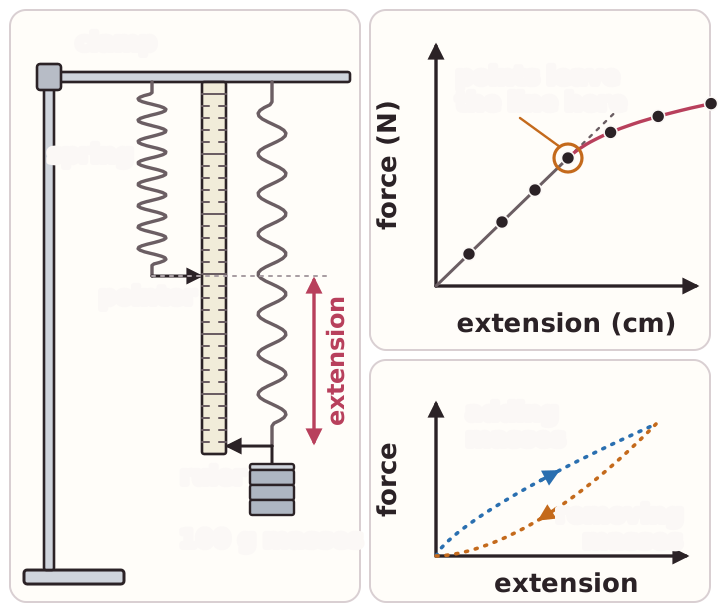
The extension of a spring is how much longer it gets. It is the new length minus the original length. To investigate, hang a spring from a clamp, measure its original length, then add weights one at a time. Each time, measure the new length and work out the extension. The force stretching the spring is the weight of the masses added, and a 100 g mass has a weight of about 1 N.
For a spring, the extension is directly proportional to the force applied. Doubling the force doubles the extension. This relationship is called Hooke's law. If you plot force against extension, the points make a straight line through the origin. This only holds up to the spring's limit of proportionality. Past that point the extension grows by more than the straight line predicts.
Other simple systems can behave differently. An elastic band does not give a straight line on a force-extension graph, and its graph for loading is not the same as its graph for unloading. The relationship between force and extension is different for different objects.