Momentum is a property of a moving object. It is the mass of the object multiplied by its velocity: momentum = mass × velocity, or p = m × v. Momentum is measured in kilograms metres per second (kg m/s). It has a direction, the same as the velocity. A 1000 kg car moving at 20 m/s has a momentum of 20 000 kg m/s.
In a collision, momentum is passed between objects. In a closed system, with no external forces acting, the total momentum before a collision is equal to the total momentum after it. We say that momentum is conserved. This is the law of conservation of momentum.
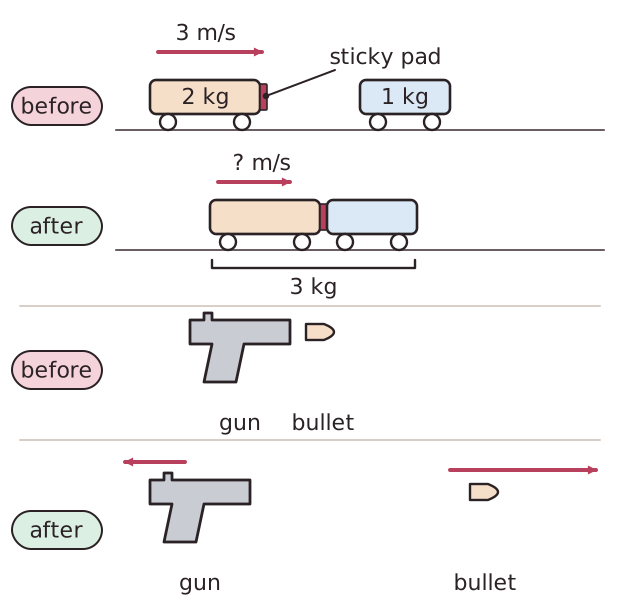
Example: a 2 kg trolley moves at 3 m/s and hits a stationary 1 kg trolley. They stick together. The total momentum before is 2 × 3 = 6 kg m/s. After the collision, the total mass is 3 kg, so the speed is 6 ÷ 3 = 2 m/s.
The same idea works for explosions. A water rocket pushes water downwards, and the rocket gains an equal amount of momentum upwards, so the total momentum stays the same.