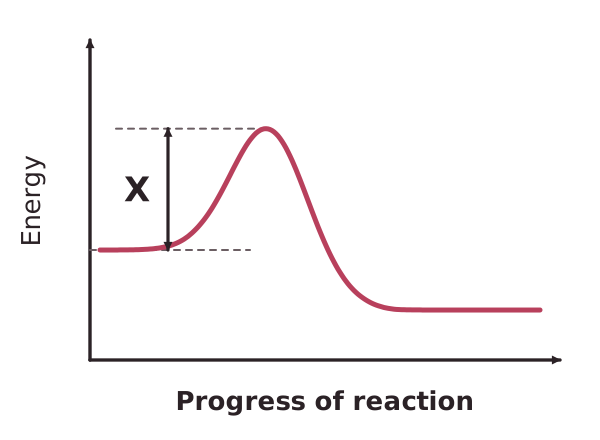
Reactions do not start just because reactants are mixed. For particles to react they must collide, and they must collide with enough energy. The minimum energy that colliding particles need for a reaction to occur is called the activation energy.
This energy is needed to start breaking the bonds in the reactants. If a collision has less energy than the activation energy, the particles simply bounce apart and nothing happens. If a collision has at least the activation energy, the bonds can break and the reaction can happen.
This explains why some reactions need a spark, a flame or heating to get going. A candle does not burn until it is lit, but once it is burning it is still an exothermic reaction. The match supplies the activation energy, and the reaction then releases more energy than was put in, which keeps it going.
On a reaction profile the activation energy is the height from the reactants to the top of the peak. A reaction with a high activation energy is slow at room temperature because few collisions have enough energy.