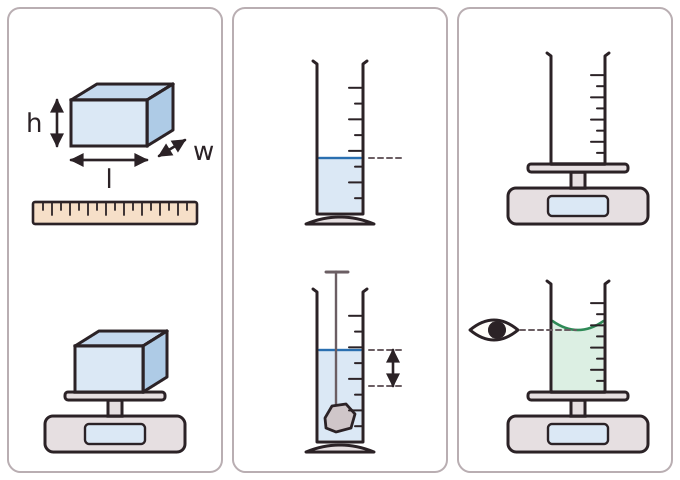
The aim is to find the density of a regular solid, an irregular solid and a liquid. In each case you measure the mass and the volume, then use density = mass ÷ volume.
For a regular solid such as a block, measure the length, width and height with a ruler and multiply them to get the volume. Zero the balance, then find the mass of the block.
For an irregular solid such as a stone, find the mass on the balance. Find the volume by displacement: lower the stone into a measuring cylinder part filled with water and subtract the starting reading from the final reading. The rise in water level is the volume of the stone. Read the scale at eye level, at the bottom of the meniscus.
For a liquid, find the mass of an empty measuring cylinder. Pour in the liquid, read its volume at the meniscus, then find the mass again. Subtract the empty mass from the full mass to get the mass of the liquid. Repeat the readings and calculate an average to reduce random errors. Water should give about 1000 kg/m3, which is the same as 1 g/cm3. To convert g/cm3 to kg/m3, multiply by 1000. For example, 0.8 g/cm3 is 800 kg/m3.