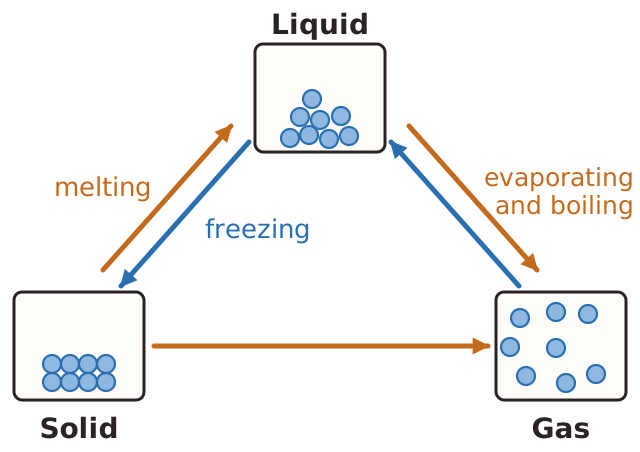
Substances can change state in six ways. Melting is solid to liquid and freezing is liquid to solid. Evaporating and boiling are both liquid to gas, and condensing is gas to liquid. A solid that turns straight into a gas without becoming a liquid first sublimates. Dry ice and iodine do this. Evaporation happens only at the surface of a liquid at any temperature, while boiling happens throughout the liquid at its boiling point. These changes are physical changes.
In a physical change the particles stay the same. No particles are gained or lost and only their arrangement and movement change. So the mass is conserved. For example, 50 g of ice melts to 50 g of water. A gas condenses to a liquid and a solid sublimates to a gas with no change in total mass either.
A physical change is reversible, and the material recovers its original properties. Water that is frozen and melted again is still water with the same melting point. Some chemical changes are different. Burning and rusting make new substances with different properties, and the original material cannot easily be recovered.