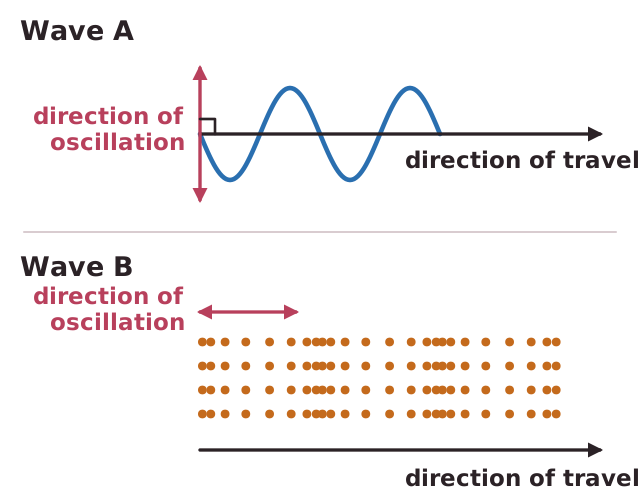
All electromagnetic waves are transverse waves. In a transverse wave the oscillations are at right angles to the direction in which the wave travels and transfers energy. This is different from a longitudinal wave, such as sound, where the oscillations are along the direction of travel.
Electromagnetic waves can travel through a vacuum, which is empty space with no particles, so they do not need a medium. That is how light from the Sun reaches the Earth across space. In a vacuum, all electromagnetic waves travel at the same speed, about 3 × 10⁸ m/s, whatever their frequency or wavelength. Radio waves, light and X-rays differ in frequency and wavelength, but not in speed in a vacuum.
Using speed = distance ÷ time, light travelling the 1.5 × 10¹¹ m from the Sun takes about 500 s, or roughly eight minutes, to reach us.