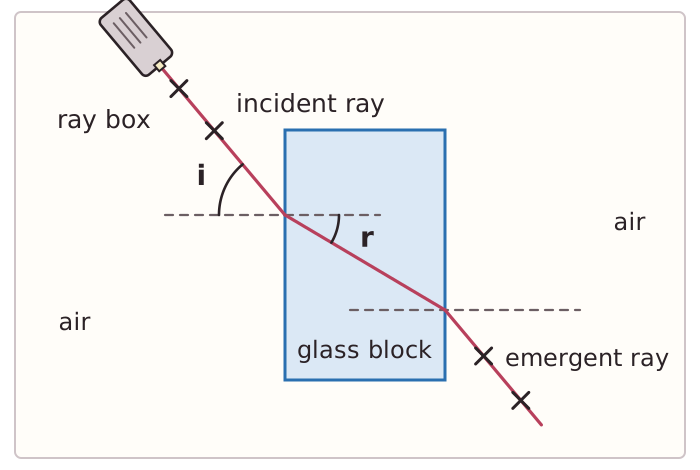
When a ray of light passes from one material into another at an angle, its speed and direction change. This is refraction. Light travels more slowly in glass than in air, so when it enters a glass block at an angle it bends towards the normal, which is a line at right angles to the surface. When it leaves the block it speeds up and bends away from the normal. Some light is also reflected at the surface. Because the ray bends back by the same amount on leaving, the emergent ray is parallel to the incident ray, but shifted sideways.
Method: place a rectangular block on a sheet of paper and draw around it. Draw a normal at a point on one side. Use a ray box to send a narrow ray at that point, at a chosen angle of incidence. Mark the incident ray and the emergent ray with crosses. Remove the block, join the crosses with a ruler, and join the entry and exit points to show the path inside the block. Use a protractor to measure the angle of incidence and the angle of refraction from the normal. Repeat for a range of angles of incidence, for example 10 to 70 degrees.
The independent variable is the angle of incidence and the dependent variable is the angle of refraction. Keep the same block and the same colour of light. When the ray enters the glass, the angle of refraction is always smaller than the angle of incidence, and the two increase together. A ray travelling along the normal, with an angle of incidence of 0 degrees, is not bent. Take care, as a ray box can get hot.