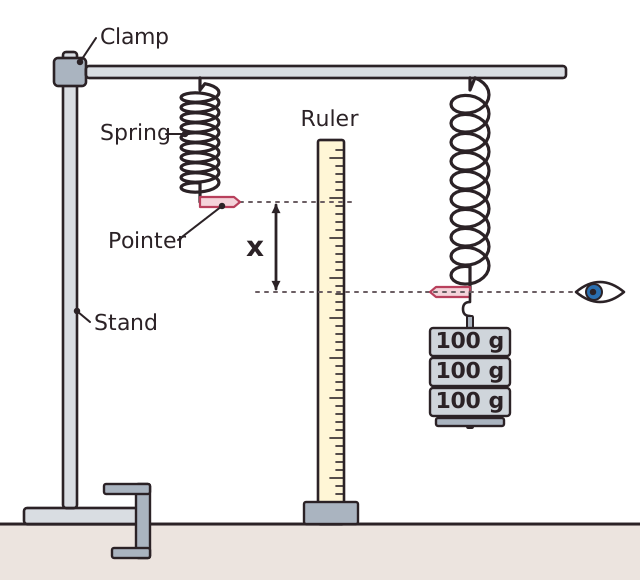
For many springs, the extension is directly proportional to the force applied, as long as the spring is not stretched too far. This is called linear elastic distortion. If you double the force, the extension doubles. The extension is the new length minus the original length.
The relationship is written as an equation:
force = spring constant × extension
F = k × x
Force F is in newtons (N), the spring constant k is in newtons per metre (N/m) and the extension x is in metres (m).
The spring constant tells you how stiff a spring is. A large spring constant means a stiff spring that needs a big force to stretch it. A small spring constant means a spring that stretches easily.
Worked example: a force of 6 N stretches a spring by 0.03 m. The spring constant is k = F ÷ x = 6 ÷ 0.03 = 200 N/m. Another spring has k = 50 N/m. A force of 4 N gives an extension x = F ÷ k = 4 ÷ 50 = 0.08 m. Always convert centimetres to metres first, for example 8 cm = 0.08 m.