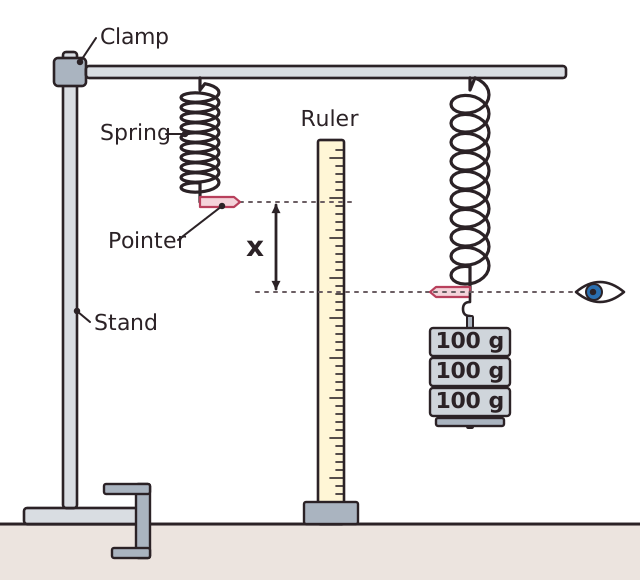
Aim: to investigate how the extension of a spring depends on the force applied, and to find the work done in stretching it.
Method: clamp the spring from a stand and measure its original length with a metre rule. Hang a mass hanger from the spring. Add a 100 g mass, which gives a force of 1 N, and measure the new length. Keep adding 100 g masses and measuring until you have at least six readings. Extension = new length - original length. Read the ruler at eye level, or use a pointer taped to the spring, to avoid reading errors. Remove the masses at the end and check the spring has gone back to its original length.
Variables: the independent variable is the force (the weight added). The dependent variable is the extension. The control variables are the same spring and the same ruler. Stay within the limit of proportionality so the spring is not permanently stretched.
Results: plot force on the vertical axis against extension on the horizontal axis and draw a line of best fit. For a spring this is a straight line through the origin. The gradient is the spring constant. The work done in stretching is the area under the graph, which equals 0.5 × k × x2.
Safety: wear eye protection in case the spring snaps, and keep feet away from falling masses.