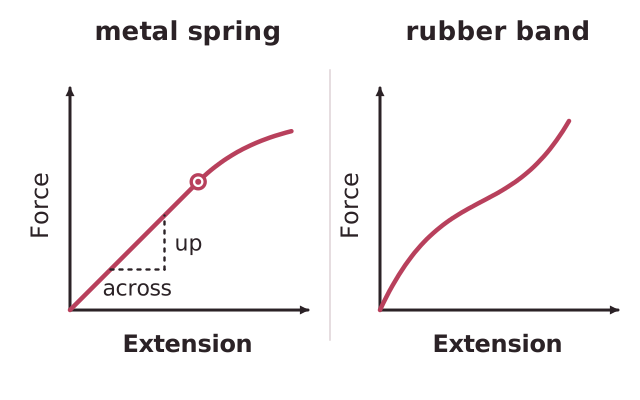
A force-extension graph has force on the vertical axis and extension on the horizontal axis. For a spring stretched within its limit, the graph is a straight line through the origin. This is a linear relationship, and it means force is directly proportional to extension. The gradient of the line is the spring constant k.
If a spring is stretched too far, the line bends over. The point where the line stops being straight is called the limit of proportionality. After this point, the graph is a curve. The relationship is now non-linear, which means force is no longer proportional to extension. Beyond this the spring may also be distorted inelastically.
Some objects are non-linear from the start. A rubber band gives a curved line on a force-extension graph even for small loads. The extension is not proportional to the force, so a single spring constant cannot be used.
To tell the difference, check two things: is the graph a straight line, and does it pass through the origin? If both are true, the relationship is linear.