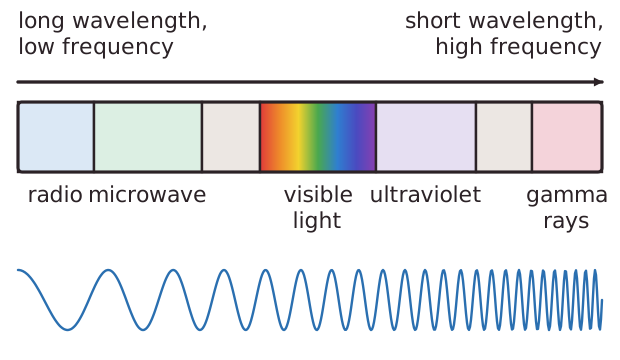
Electromagnetic waves are transverse waves, so their oscillations are at right angles to the direction the wave travels. They transfer energy from a source to an absorber. For example, light and infrared radiation from the Sun carry energy across space to the Earth, where the surface absorbs it. The waves inside a microwave oven carry energy to the food, which absorbs it and heats up.
The waves form one continuous electromagnetic spectrum. All types of electromagnetic wave travel at the same velocity through a vacuum (space) or air. They differ in wavelength and frequency, and the groups are named by these. A wave with a higher frequency has a shorter wavelength. From long wavelength (low frequency) to short wavelength (high frequency) the groups are: radio, microwave, infrared, visible light (red to violet), ultraviolet, X-rays and gamma rays.
Our eyes can only detect visible light, so we detect just a small part of the whole spectrum.