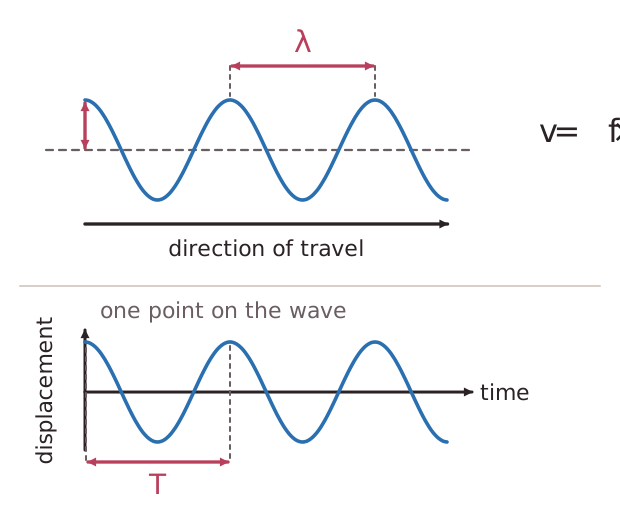
A wave can be described using four quantities. The amplitude is the maximum displacement of a point on the wave from its undisturbed position. The wavelength, λ, is the distance from a point on one wave to the equivalent point on the adjacent wave, for example from one crest to the next crest. The frequency, f, is the number of waves passing a point each second, measured in hertz (Hz). The period, T, is the time taken for one wave to pass, measured in seconds (s).
Period and frequency are linked by the equation T = 1 ÷ f. A wave with a frequency of 4 Hz has a period of 1 ÷ 4 = 0.25 s. A higher frequency means a shorter period.
The wave speed, v, is the speed at which the energy is transferred, or the wave moves, through the medium. All waves obey the wave equation: wave speed = frequency × wavelength, or v = f λ. Wave speed is in metres per second (m/s), frequency in hertz (Hz) and wavelength in metres (m). A wave with a frequency of 5 Hz and a wavelength of 0.2 m has a speed of 5 × 0.2 = 1 m/s.
To measure the speed of sound in air, you can stand a measured distance from a large wall, make a loud sound and time the echo, or use two microphones a known distance apart connected to a data logger. Speed is distance divided by time. For the echo method the sound travels to the wall and back, so the distance travelled is twice the distance to the wall. To measure the speed of ripples on a water surface, use a ripple tank: a strobe light can appear to freeze the ripples so that you can measure the wavelength with a ruler, and counting the ripples made each second gives the frequency. Then use v = f λ. The same idea works for waves in a solid, such as a stretched cord shaken by a vibration generator.