The rate of reaction tells you how fast reactants are used up or how fast products are formed. To find the mean rate, measure the quantity of a reactant used, or the quantity of a product formed, and divide by the time taken. So mean rate of reaction = quantity of reactant used ÷ time taken, or mean rate of reaction = quantity of product formed ÷ time taken.
The quantity can be measured as a mass in grams, or as a volume in cm3, for example the volume of a gas collected. The units of rate are therefore g/s or cm3/s. For example, 40 cm3 of gas made in 10 s gives a mean rate of 4 cm3/s. Higher tier students must also be able to measure the quantity of a reactant in moles, giving a rate in mol/s.
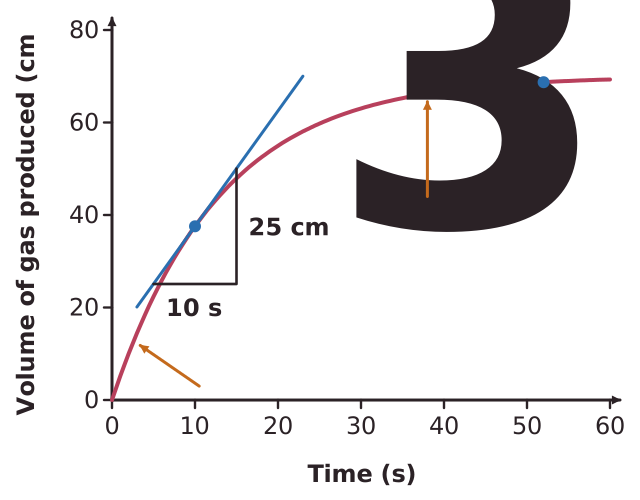
A graph of the quantity of product formed against time starts steepest, because the rate is fastest at the start when the reactants are at their highest concentration. The line then curves and becomes less steep as reactants are used up. It goes flat when one reactant has run out and no more product forms. A reactant used up against time gives a curve that falls instead.
To find the rate at one moment, draw a tangent to the curve at that time. The slope of the tangent is a measure of the rate at that time. A steeper slope means a faster rate. Higher tier students work out the gradient of the tangent (change in the quantity ÷ change in time) to give a value for the rate.