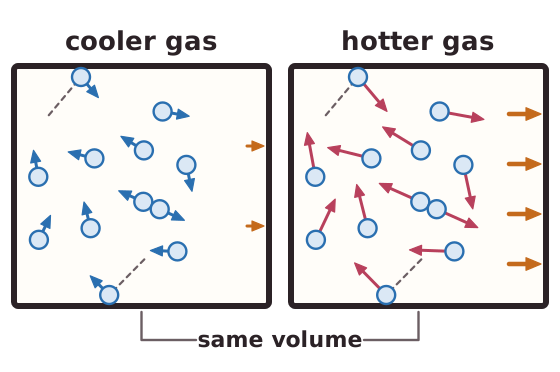
The molecules of a gas are in constant random motion. They move quickly in straight lines in all directions, and they change direction when they collide with each other or with the walls of the container. There are large gaps between the molecules, so there is very little force between them except during collisions.
The temperature of a gas is related to the average kinetic energy of its molecules. If you heat a gas, its molecules gain kinetic energy and move faster on average. If you cool the gas, the molecules move more slowly on average. The molecules do not all move at the same speed, which is why we talk about the average kinetic energy.
The pressure of a gas is caused by its molecules hitting the walls of the container. Each collision gives the wall a tiny force, and the huge number of collisions every second adds up to a steady pressure acting on the wall.
Now keep the volume of the gas constant and raise its temperature. The molecules move faster, so they hit the walls more often and with more force each time. The pressure goes up. Cooling the gas at constant volume does the opposite: the molecules hit the walls less often and with less force, so the pressure falls. So at constant volume, a higher temperature means a higher pressure.