The density of a material tells you how much mass is packed into a given volume. You find it by dividing the mass by the volume: density = mass ÷ volume, or ρ = m ÷ V. Density is measured in kilograms per metre cubed, mass is measured in kilograms and volume is measured in metres cubed. For example, a block of 600 kg that fills 2 m3 has a density of 600 ÷ 2 = 300 kg/m3.
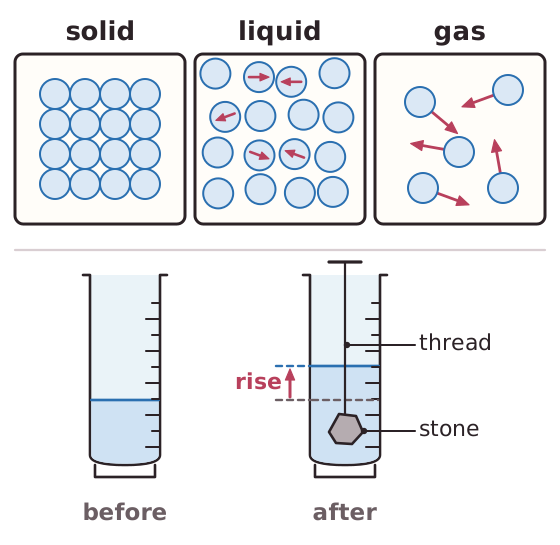
The particle model explains why the three states of matter have different densities. In a solid the particles are held in a fixed pattern and are touching, so they are closely packed. In a liquid the particles are also close together but are free to move past each other. In a gas the particles are far apart and move quickly in random directions. A gas therefore has far fewer particles, and so far less mass, in the same volume. This is why solids and liquids usually have a much higher density than gases.
When a substance changes state its mass is conserved, because the particles are not lost. Only the spacing between them changes, so the volume changes and the density changes with it. If a gas expands to twice its volume, the same mass is now spread through twice the volume, so its density halves.
In the required practical you measure density for different objects. Use a balance to find the mass. For a regularly shaped solid, measure its dimensions with a ruler, micrometer or Vernier callipers and work out the volume from them. For an irregular solid, use a displacement method: the volume of water it pushes out, or the rise in water level when it is lowered into a measuring cylinder, equals the volume of the solid. For a liquid, measure its mass in a container on a balance and its volume in a measuring cylinder.