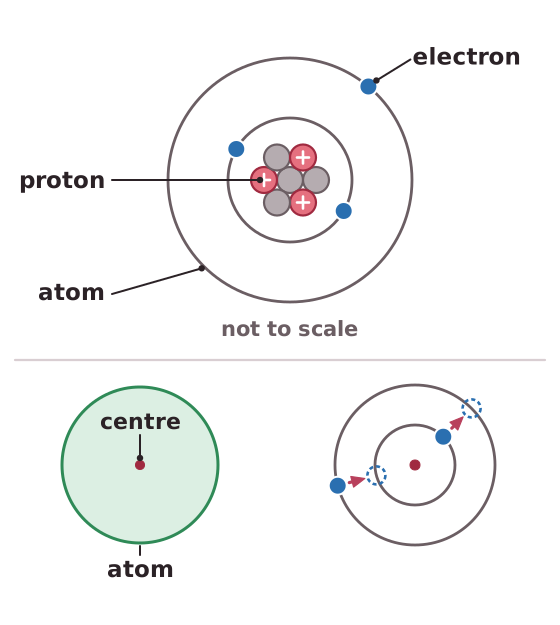
Atoms are very small. An atom has a radius of about 1 × 10⁻¹⁰ m. At the centre is a nucleus, which is positively charged and made of protons and neutrons. Negatively charged electrons surround the nucleus.
The nucleus is far smaller than the atom as a whole. Its radius is less than 1/10 000 of the radius of the atom. Even so, most of the mass of an atom is concentrated in the nucleus, because protons and neutrons are much heavier than electrons.
The electrons are arranged at different distances from the nucleus. These distances are different energy levels. If an electron absorbs electromagnetic radiation, it can move further from the nucleus to a higher energy level. If an electron emits electromagnetic radiation, it moves closer to the nucleus to a lower energy level.