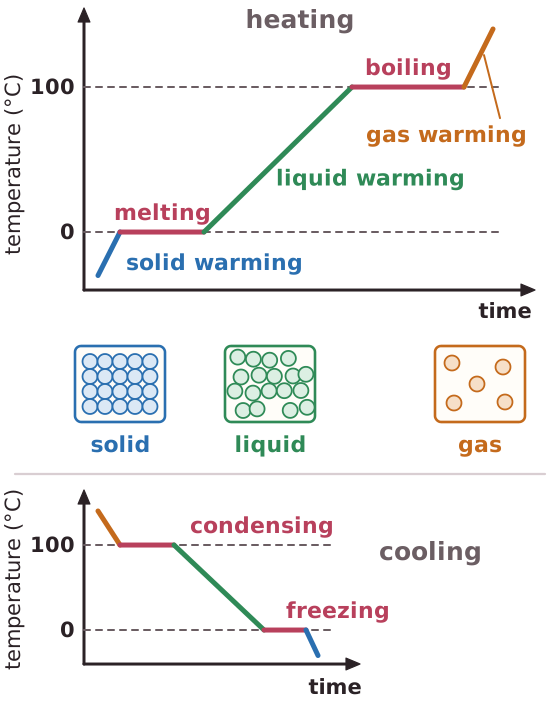
The energy needed for a substance to change state is called latent heat. When a change of state happens, the energy supplied changes the internal energy stored by the particles, but not the temperature. The energy goes into the potential energy of the particles as they separate, not into making them move faster, so the temperature stays constant while a solid melts or a liquid boils.
The specific latent heat of a substance is the amount of energy required to change the state of one kilogram of the substance with no change in temperature. The specific latent heat of fusion is for the change from solid to liquid. The specific latent heat of vaporisation is for the change from liquid to vapour. It is measured in joules per kilogram, J/kg.
The energy for a change of state = mass × specific latent heat, or E = m L. The energy E is in joules (J), the mass m is in kilograms (kg) and the specific latent heat L is in J/kg. Worked example: boiling 2.0 kg of water at 100 °C, with a specific latent heat of vaporisation of 2260000 J/kg, needs E = 2.0 × 2260000 = 4520000 J. The specific latent heat of fusion of water is 334000 J/kg.
A heating graph of temperature against time for a solid shows sloping sections, where the temperature rises, and flat sections, where the substance is melting or boiling. On a cooling graph, the flat sections show freezing or condensing. Do not mix up the two quantities. Specific heat capacity is used when the temperature changes. Specific latent heat is used when the state changes and the temperature does not.