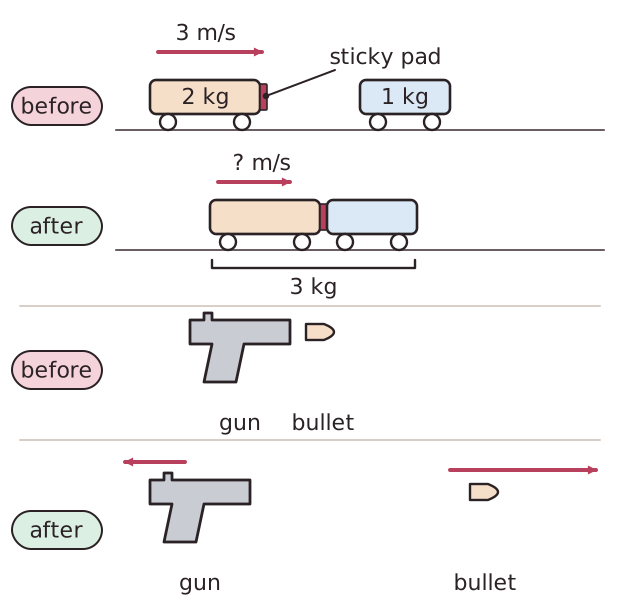
In a closed system, no external forces act on the objects, so nothing outside the system adds or removes momentum. In a closed system, the total momentum before an event is equal to the total momentum after the event. This is called conservation of momentum. It applies to collisions and to objects pushing each other apart.
In a collision, momentum is passed from one object to another. One object may lose momentum, but the other gains exactly the same amount, so the total stays constant. You can investigate this with laboratory trolleys, using light gates, data loggers or ticker timers to measure the velocities before and after.
For example, a 2 kg trolley moving at 3 m/s sticks to a stationary 1 kg trolley. The total momentum before is 2 × 3 = 6 kg m/s. After the collision the joined trolleys have a mass of 3 kg, and the momentum is still 6 kg m/s, so the velocity is 6 ÷ 3 = 2 m/s.
Objects can also push apart. A gun and a bullet are at rest before firing, so their total momentum is zero. When the bullet moves forwards, the gun moves backwards. This is called recoil. The momentum of the gun is equal in size and opposite in direction to the momentum of the bullet, so the total momentum after firing is still zero.